Evidence Before Opinion
Start with payments, wallets, messages and platform records.

Crypto Scam & Fraud Support
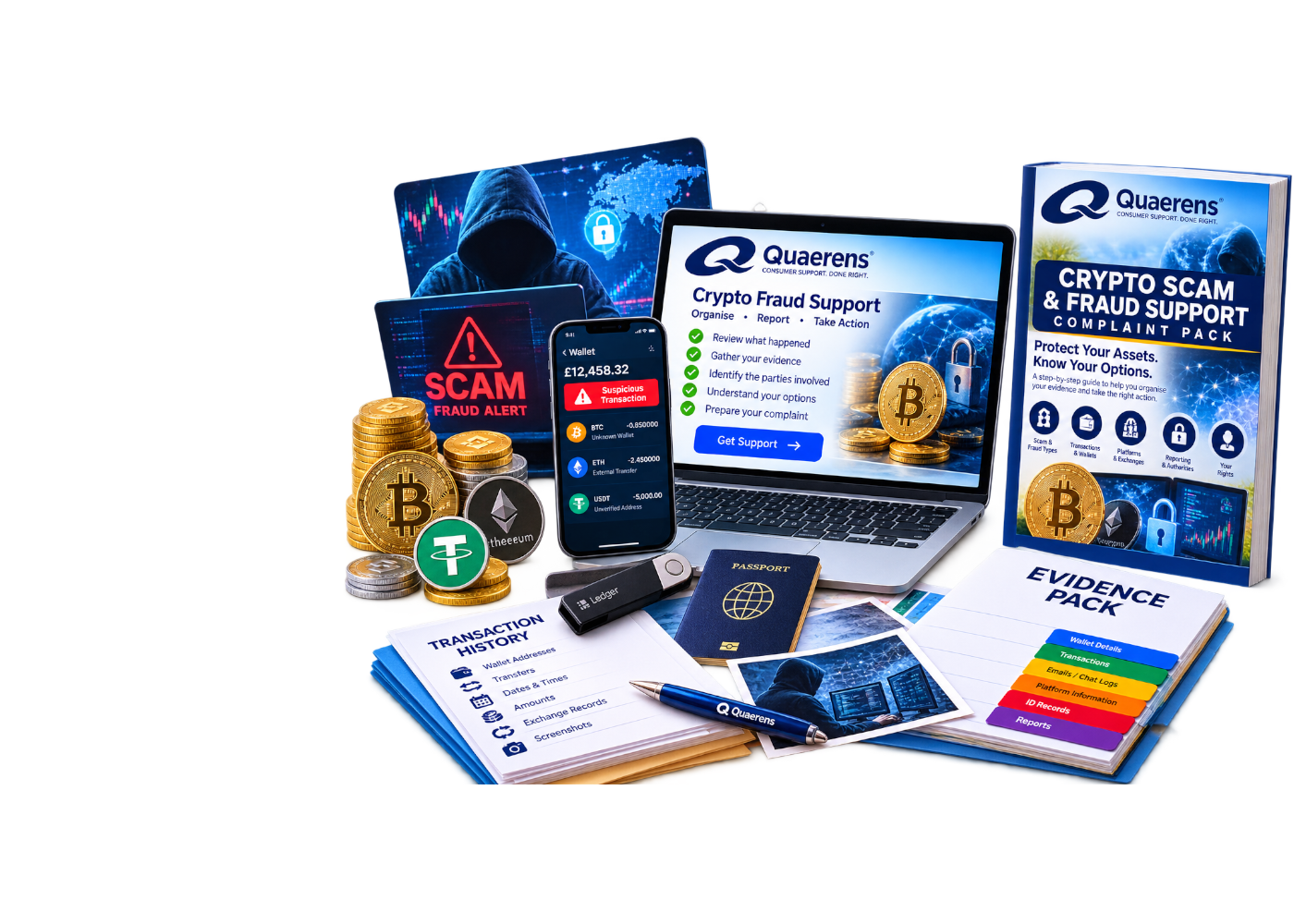
Fake trading platforms, wallet transfers, blocked withdrawals and recovery scams can leave payments, messages and account records spread across several services. Quaerens helps organise the evidence, map what happened and clarify which complaint or reporting routes may need consideration.
Before you send any more money
If someone says a withdrawal fee, tax, AML charge, verification fee, liquidity payment, wallet activation, insurance, legal fee or recovery fee must be paid before funds can be released, do not treat that request as proof that the money exists or will be returned. Verify unexpected requests independently.
Second-scam risk
Victims may later be contacted by people claiming to be recovery specialists, solicitors, regulators, police, government bodies, blockchain investigators, liquidators, banks or exchanges. They may say funds have been located and demand tax, cryptocurrency, a release fee or remote access. Unexpected approaches should be independently checked before money or sensitive information is provided.
Start with payments, wallets, messages and platform records.
Quaerens does not guarantee cryptocurrency or money can be recovered.
We organise evidence; we do not hack wallets or reverse transactions.
Be cautious about further payments, remote access and recovery offers.
Understand the reported pattern
These categories organise reported events; they do not automatically diagnose a criminal offence.
A professional-looking dashboard shows apparent trading activity or profits.
A withdrawal is stopped and another fee, tax or deposit is demanded.
Crypto is sent to an address supplied by another person or platform.
A real organisation's name, logo or registration details may have been copied.
Trust develops through social or dating contact before investment is introduced.
Someone asks to control a device while banking, exchange or wallet services are open.
A second organisation promises recovery after an earlier loss and requests payment.
An advert or profile uses a celebrity, platform or public figure's imagery.
Fake platforms and withdrawals
Contact may begin online before a convincing dashboard is shown. Several deposits may follow; a small withdrawal can sometimes be allowed, then a larger withdrawal is blocked. Preserve the exact domain, account details, dashboard screenshots, deposits, withdrawal requests, support chats and company claims.
Record the exact reason given, such as tax, verification, AML, liquidity, upgrade, insurance or release fee. A genuine identifiable platform dispute must be distinguished from a suspected fraudulent platform.
Wallet and blockchain records
An identifier used to send or receive cryptocurrency. It may show where a transaction was sent but does not automatically establish the real-world owner.
A unique blockchain transaction identifier that may show the network, addresses, amount, time and status. It is not proof of the recipient's identity.
Some networks expose public transaction data. Quaerens does not reverse transactions, seize assets, control wallets or perform forensic attribution.
Transaction trail
A common path may be bank or card → exchange → crypto purchase → external wallet → possible further wallet or platform. Not every case follows that route.
Payment date, amount, warning, beneficiary and complaint history.
Account holder, fiat deposit, crypto purchase and withdrawal record.
Token, network, addresses, transaction hash and who supplied the address.
Dashboard, displayed balance, terms, messages and withdrawal demand.
Bank, exchange, platform and official fraud-reporting responses.
Banks, cards and exchanges
Keep statements, transfer records, warnings, calls, recall attempts, fraud correspondence, the complaint and final response. Do not assume the bank is liable merely because it processed a payment.
Keep the statement, merchant descriptor, correspondence and issuer response. Credit card does not mean automatic Section 75 liability; debit card does not mean automatic chargeback entitlement.
An exchange may have been used to buy and send crypto without being the alleged scammer. Distinguish an exchange used in the payment path from one that is itself the subject of an account or service dispute.
Current APP reimbursement requirements apply to defined payment routes and circumstances. A bank → consumer's own exchange → external wallet path must not be treated as identical to a direct bank transfer to a fraudster's bank account.
Security and impersonation
Record the software, date, who requested it, phone or email, session timing and payments made. Do not reinstall software or conduct unsafe technical investigation. If access may remain, use a trusted device and official bank/exchange routes to secure accounts.
Keep the original profile, username, messages, phone number, platform URL, payment instructions and wallet addresses. Use sensitive, non-blaming language: trust may have been deliberately built before investment was introduced.
Verify telephone numbers, emails and websites through independent official sources. A genuine firm's name and registration can be copied.
Keep adverts, profiles, URLs, dates, certificates and regulatory claims. Describe a document as requiring verification unless authoritative evidence establishes it is false.
Official verification and reporting
Authorisation, registration and permission for a specific service are different questions. Absence from a warning list does not prove a business is genuine or safe.
Check whether a firm is authorised and has the permission for the service it offers. Independently compare its official contact details.
Check with the FCASearch current warnings, remembering that no list can contain every potentially fraudulent business.
Check FCA warningsReport Fraud is the current national reporting service for England, Wales and Northern Ireland. Scotland uses Police Scotland via 101.
Open Report FraudOfficial reporting is separate from asking Quaerens for support. A report reference can be useful, but reporting does not guarantee investigation or recovery.
Preserve before it disappears
Exact domain, URLs, screenshots, dashboard, withdrawal screen, support chat, terms and date captured.
Messages, emails, usernames, phone numbers, voice messages and call logs. Do not continue contact solely to gather evidence.
Bank/card records, exchange history, token, network, wallet addresses, hashes, recalls and complaints.
Names, company claims, email domains, beneficiary details, software and session evidence. Do not send secret credentials.
Chronology and facts
Record first contact, adverts, account opening, each payment, crypto purchase, wallet transfer, apparent profit, withdrawal, fee demand, reports, complaints and any later recovery approach.
Write “the platform displayed an apparent balance of £250,000”, not “the account contained £250,000”. Write “the consumer was told £15,000 described as tax was required”, not “£15,000 tax was due”.
Choose the principal route
For genuine platform administration, restriction, execution, withdrawal or service issues.
Open routeFor a genuine digital platform or system failure rather than suspected fraud.
Open routeWhere the principal unresolved issue is bank handling, reimbursement or the final response.
Open routeWhere a relevant credit-card transaction structure may support separate review.
Open routeWhere a card-payment dispute and current scheme rules may be relevant.
Open routeWhere overseas entities, jurisdictions or international structure become the main complexity.
Open routeSupport process
Independently verify further fee, tax, release or recovery requests.
Keep payments, wallets, hashes, screenshots, messages and company claims.
Show how funds moved through banks, exchanges, wallets and platforms.
Record contact, payments, promises, withdrawal problems and reports.
Identify bank, exchange, reporting, platform or specialist next steps.
You do not need technical or legal terminology. Start with the records you have.
Crypto Scam & Fraud Document & Evidence Guide
Bank payments, exchange records, wallet addresses, transaction hashes, platform screenshots and communications can show how money moved, what was said and what happened when a withdrawal or report was made.
Submit Your Information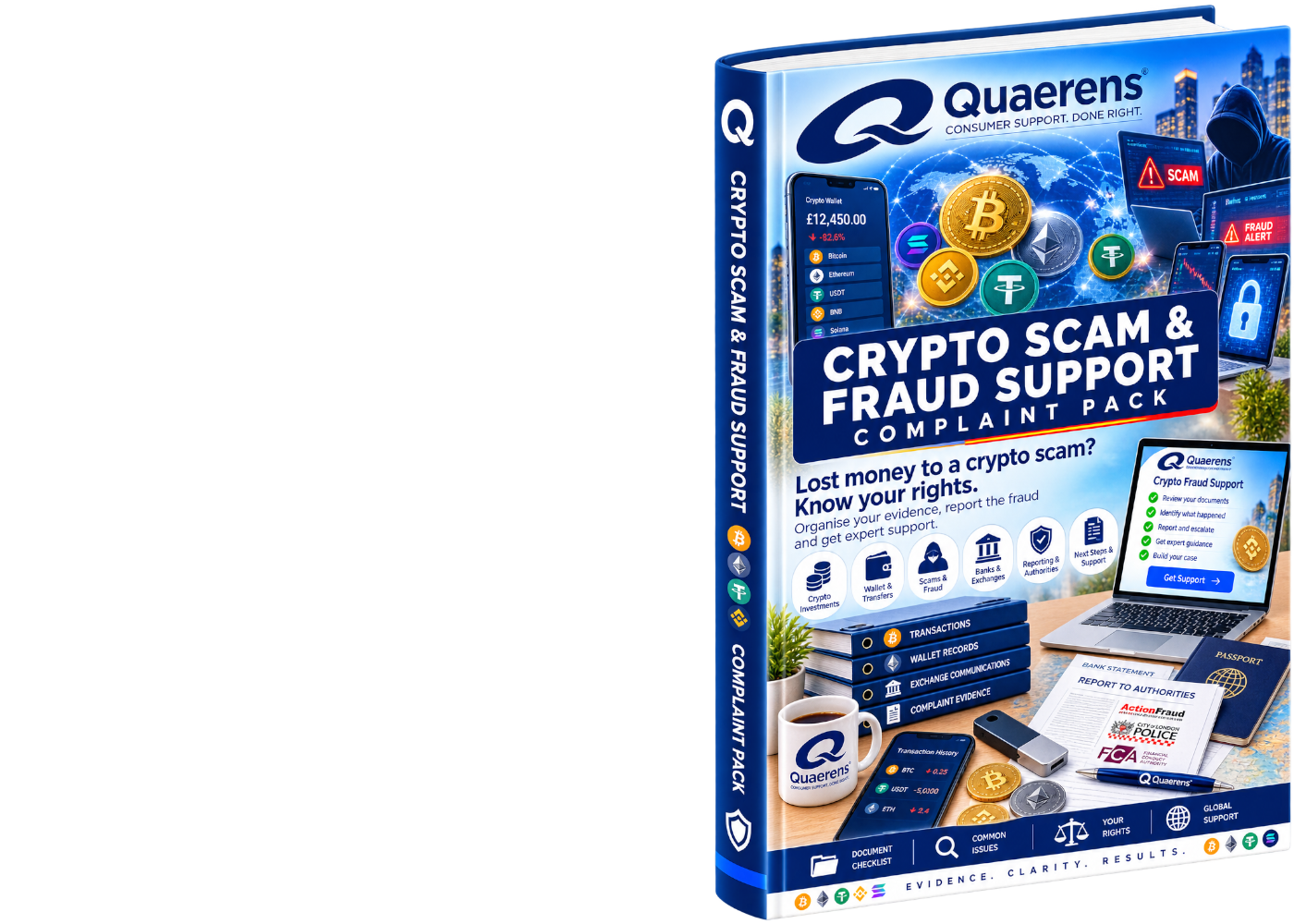
Example situations
A dashboard displays increasing profits, then demands a tax or release payment. The records document what was shown and requested; they do not prove the profits exist.
A consumer buys crypto through their own exchange account and transfers it to an address supplied by someone presenting an opportunity. Bank, exchange, hash and message records reconstruct the path.
Someone guides banking and exchange activity using remote-access software. Record the request, sessions, payments and communications without accusing the software provider.
A later organisation says funds have been located and demands an upfront payment. Treat the new contact and payment as a separate evidence trail.
Illustrative only. Whether conduct amounts to fraud and which routes are available depend on the facts, evidence, payment path and parties.
Read the detailed evidence guide covering screenshots, wallet information, fee demands and communications.
Read the Evidence GuideCommon questions
Prefer to speak first?
If you are unsure whether the issue concerns a suspected scam, your bank, an exchange, a genuine platform or a recovery company, request a callback before submitting information.